

San Jose
Team Scoring Insights
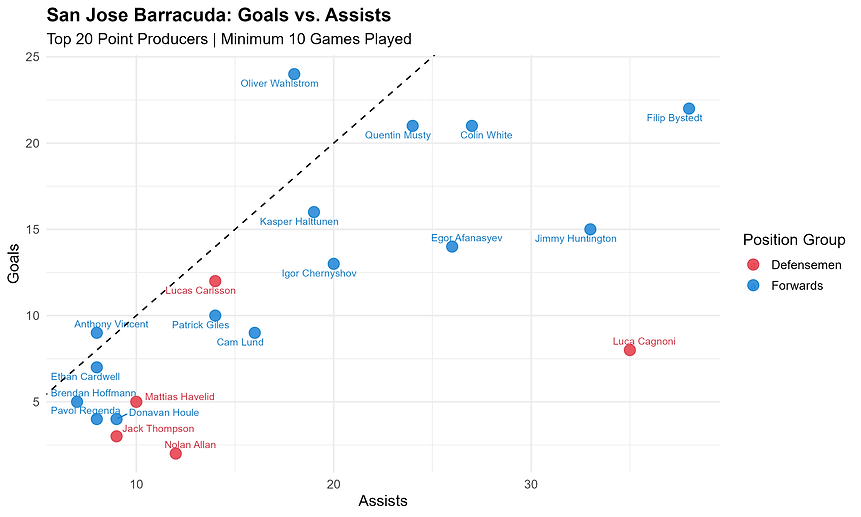
The San Jose Barracuda featured a highly skill-oriented offensive profile with several strong playmakers and multiple forwards producing high assist totals. The roster appears built around puck movement, offensive creativity, and balanced scoring contributions across the top of the lineup.
Filip Bystedt emerged as the club’s top offensive centerpiece. His combination of 22 goals and a very high assist total places him among the most complete offensive players on the roster, capable of both finishing and facilitating at a high level.
Colin White and Quentin Musty also delivered strong dual-threat production. Both players combined 20+ goals with major playmaking numbers, giving San Jose multiple reliable offensive drivers.
Oliver Wahlstrom profiles as one of the team’s purest finishers. His 24 goals paired with more moderate assist production suggest a player whose value came heavily through shooting and finishing opportunities.
Jimmy Huntington and Egor Afanasyev provided veteran-style offensive support, leaning more toward playmaking roles while still contributing meaningful goal totals. Their positioning indicates strong complementary offensive value.
Kasper Halttunen and Igor Chernyshov rounded out an impressive group of secondary scorers. Both showed balanced production profiles and reinforced the overall depth of the Barracuda attack.
Lower in the lineup, Patrick Giles, Cam Lund, Anthony Vincent, and Ethan Cardwell supplied modest but useful offensive contributions, with most leaning slightly toward finishing rather than pure setup play.
On defense, Luca Cagnoni clearly stood out as the primary offensive defenseman. His very high assist total demonstrates strong puck-moving ability and likely significant power-play responsibility.
Lucas Carlsson also contributed notable offense from the blue line with a balanced scoring profile, while Mattias Havelid, Jack Thompson, and Nolan Allan provided more limited offensive production.
Overall, San Jose’s offensive structure appears deeper and more balanced than many AHL clubs. The Barracuda combined multiple high-end playmakers with several legitimate goal scorers, suggesting a team capable of generating offense through puck movement and sustained attacking pressure rather than relying on a single dominant scorer.
Team Dashboard

Team Dashboard Insights
The San Jose Barracuda finished with a strong 58.3% points percentage and a +13 goal differential, reflecting a team that consistently played above league average at both ends of the ice. Their profile suggests a club driven by offensive depth, balanced scoring, and solid overall puck possession.
On the Team Identity Map, San Jose sits comfortably on the positive side of the league averages in both goals for and goals against. The Barracuda were not dominant defensively, but they paired respectable defensive play with above-average offensive production, giving them one of the more balanced profiles among playoff-caliber AHL teams.
The power play was a significant asset. A 24.3% conversion rate provided San Jose with valuable secondary offense and helped elevate an already talented forward group. The 81.2% penalty kill was also solid, reinforcing the idea that special teams played a major role in the club’s success.
Filip Bystedt emerged as the centerpiece of the offense, leading the team with 60 points. His strong scoring totals combined with near-neutral plus/minus numbers suggest a player heavily relied upon in offensive situations while facing top competition.
Jimmy Huntington, Colin White, and Quentin Musty gave San Jose exceptional offensive depth. White and Huntington combined high point totals with positive plus/minus ratings, while Musty’s production despite a more negative differential highlights his high-end offensive upside.
Oliver Wahlstrom remained one of the club’s premier goal scorers, reflected by his large scoring bubble. Egor Afanasyev, Kasper Halttunen, and Igor Chernyshov added further secondary scoring depth, giving San Jose multiple dangerous attacking options throughout the lineup.
Luca Cagnoni was the standout offensive defenseman. His 43-point season and strong offensive involvement made him one of the most productive blueliners on the roster, while Lucas Carlsson added additional support from the back end.
The skater production chart shows a slightly mixed defensive profile underneath the offensive success. Several of the club’s most productive scorers still carried negative plus/minus ratings, suggesting San Jose often relied on offensive pressure rather than purely defensive control to win games.
In goal, Gabriel Carriere handled the largest workload and posted solid results around the .900 mark, giving the Barracuda dependable starting-level goaltending throughout the season.
Laurent Brossoit delivered the strongest save percentage in more limited action, while Jakub Skarek provided depth minutes with somewhat less efficient results.
Overall, San Jose profiles as a skilled, offensively driven playoff-caliber team. The Barracuda combined high-end forward depth, strong power-play performance, and productive puck-moving defensemen to create a dangerous attack, while receiving stable enough goaltending and defensive structure to maintain a positive overall goal profile.