

SPHL - Southern Professional Hockey League
2025-26 Regular Season
League-wide standings, team performance dashboards, player leaders, goalie analytics, and advanced hockey insights powered by SEE Sports.
Data-driven insights from the Southern Professional Hockey League
2025–26 League Overview
Standings, goal differential, offensive production, and expected performance across the SPHL season.

Key Insights
-
Peoria Rivermen finished as the league’s most dominant overall team, leading the SPHL in both point percentage and goal differential while combining elite defensive performance with strong offensive production.
-
Huntsville Havoc generated one of the league’s strongest offensive profiles, averaging more than three goals per game, though their underlying metrics suggest they slightly underperformed relative to expected results.
-
Roanoke Rail Yard Dawgs demonstrated one of the league’s most balanced team identities, pairing strong offensive output with solid defensive efficiency.
-
Several mid-table clubs, including Knoxville Ice Bears and Macon Mayhem, exceeded their expected win totals despite negative goal differentials, suggesting strong performance in close games.
-
Lower-ranked teams generally struggled more from defensive inefficiency than lack of scoring, reinforcing the importance of goal prevention in SPHL standings success.
-
The SPHL Team Identity Map highlights clear stylistic differences across the league, with some teams relying heavily on offensive firepower while others remained competitive through defensive structure and lower goals-against rates.
SPHL Offense vs. Defense Team Profiles
Team success in the SPHL was driven by varying combinations of offensive production and defensive efficiency. Some clubs relied heavily on scoring depth, while others separated themselves through elite goal prevention.

Key Insights
-
Peoria Rivermen combined strong scoring with elite defensive performance, giving them the league’s best overall balance profile.
-
Huntsville Havoc generated the highest offensive output in the league, averaging over three goals per game.
-
Roanoke Rail Yard Dawgs demonstrated one of the strongest two-way profiles among playoff-caliber teams.
-
Several mid-table teams produced competitive offensive numbers but struggled defensively, limiting overall standings success.
-
Defensive efficiency appeared to be a major separator between elite and lower-tier SPHL clubs.
Goal Differential and Standings Success
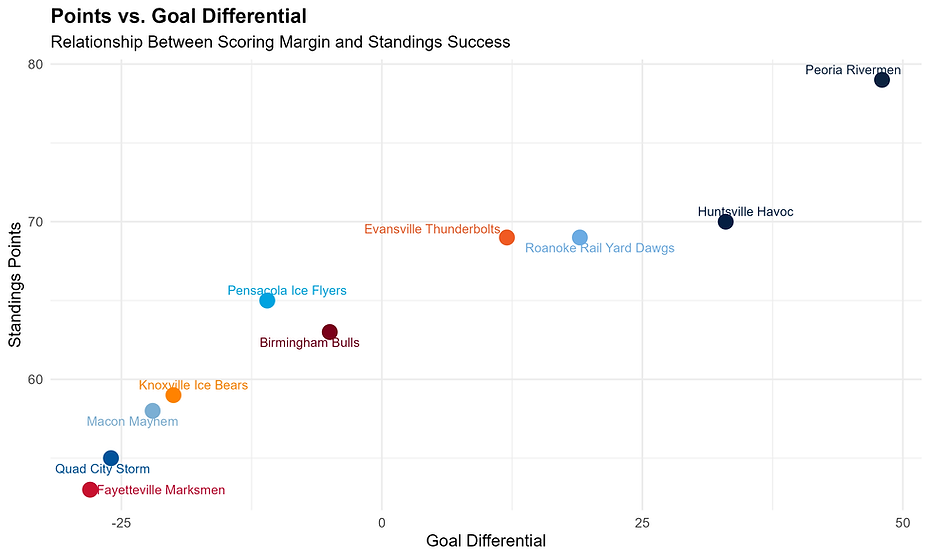
Goal differential is often one of the strongest indicators of team quality in hockey. The relationship between scoring margin and standings points in the SPHL shows a clear separation between the league’s top contenders and lower-tier clubs.
Key Insights
-
Peoria Rivermen separated themselves from the rest of the league with both the highest standings point total and the strongest goal differential.
-
Huntsville Havoc and Roanoke Rail Yard Dawgs also demonstrated strong alignment between scoring margin and overall standings success.
-
Evansville Thunderbolts slightly outperformed their underlying goal differential relative to other top teams, suggesting strong performance in close games.
-
Several lower-ranked clubs posted significantly negative goal differentials, reinforcing the importance of sustained two-way play over the course of the season.
-
The relationship between goal differential and standings points appears highly consistent across the SPHL, highlighting scoring margin as a strong indicator of team quality.
League Skater Leaders
Offensive production across the SPHL featured a mix of elite playmakers, high-volume scorers, and efficient finishers. The league’s top skaters combined scoring consistency with strong per-game production throughout the 2025–26 season.

Key Insights
-
Joe Widmar led the league in total points, combining elite playmaking with strong finishing ability throughout the season.
-
Michael McChesney emerged as one of the SPHL’s most dangerous pure goal scorers, leading the league in goals while maintaining strong shooting efficiency.
-
Several top offensive players balanced scoring and playmaking effectively, while others demonstrated more specialized offensive profiles as either finishers or distributors.
-
Per-game scoring metrics highlighted the separation between elite offensive contributors and volume-based accumulators with heavier workloads.
-
Shooting percentage analysis revealed several highly efficient scorers who converted opportunities at rates significantly above league averages.
Offensive Forward Analysis
The SPHL’s top forwards drove offensive production through a combination of scoring efficiency, shot generation, and playmaking ability. The league featured a diverse mix of high-volume scorers, balanced offensive creators, and efficient finishers.

Key Insights
-
Joe Widmar finished as the league’s top offensive producer, leading all forwards in total points while also ranking among the leaders in assists.
-
Michael McChesney emerged as one of the SPHL’s premier finishers, leading the league in goals scored and maintaining strong shooting efficiency.
-
Austin Alger combined elite goal scoring with strong overall offensive balance, placing near the top of multiple offensive categories.
-
The goals-versus-assists analysis highlights clear stylistic differences among the league’s top forwards, with some players functioning primarily as finishers while others operated as high-end playmakers.
-
Several forwards maintained point-per-game production near or above the 1.0 mark, illustrating a strong concentration of offensive talent at the top of the league.
Blue-Line Production & Playmaking
Offensive contributions from defensemen played a major role in team success across the SPHL. The league’s top blue-liners combined puck movement, playmaking ability, and offensive activation from the back end to drive scoring opportunities throughout the season.

Key Insights
-
Alec Baer emerged as one of the league’s premier offensive defensemen, contributing heavily in both assists and total points.
-
Several top SPHL defensemen generated offense primarily through playmaking rather than goal scoring, emphasizing puck distribution and transition play from the blue line.
-
The point-per-game metrics highlight a small group of elite offensive contributors who separated themselves significantly from the broader defensive field.
-
Shot production and offensive efficiency varied widely among top defensemen, with some players generating offense through volume while others relied on highly efficient opportunity conversion.
-
Teams with strong offensive contributions from defensemen generally demonstrated more balanced scoring profiles and stronger overall offensive depth.
Goaltending Performance Analysis
Goaltending remained one of the strongest differentiators between top and lower-tier SPHL clubs during the 2025–26 season. The league’s best netminders combined save efficiency, workload management, and consistency to help stabilize team performance across the regular season.

Key Insights
-
Brad Barone ranked among the league leaders in save percentage while also handling one of the heaviest workloads of any SPHL goaltender.
-
Eric Levine combined strong win totals with elite goals-against performance, reinforcing the connection between team structure and goaltending success.
-
The workload analysis highlights several goaltenders who maintained strong efficiency despite facing high shot volumes throughout the season.
-
Save percentage showed a stronger relationship with team success than raw win totals alone, particularly among playoff-caliber clubs.
-
Teams with stable, above-average goaltending generally demonstrated stronger defensive consistency and more sustainable performance over the course of the season.