

Iowa 2025-26 Season in Review
Team analytics, player leaders, offensive production, and goaltending performance from the 2025–26 ECHL season.
Team Performance Snapshot
Key Insights
-
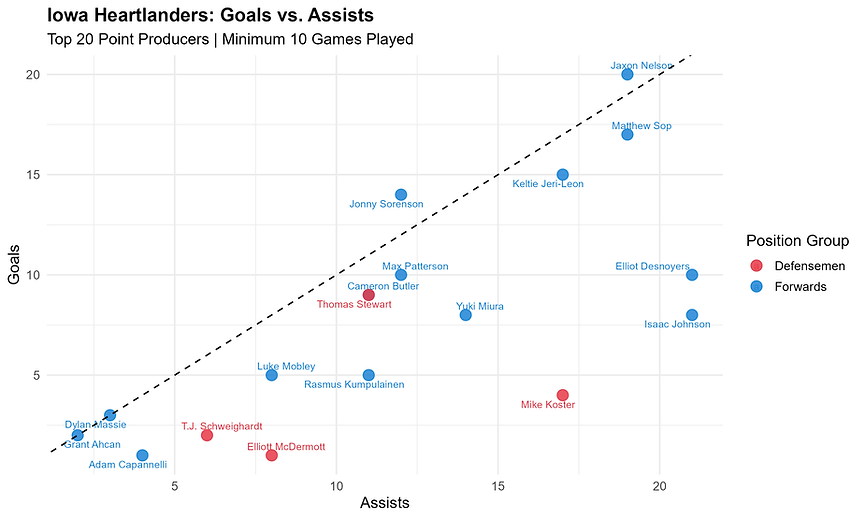
Iowa leaned heavily on playmaking forwards rather than pure finishers. Most of the team’s top scorers sit below the goals-equals-assists line, indicating a roster built more around puck movement and setup ability than elite goal scoring.
-
Jaxon Nelson emerged as the team’s top offensive threat. Nelson combined the highest goal total among key contributors with strong assist production, making him Iowa’s most balanced offensive weapon.
-
Matthew Sop and Keltie Jeri-Leon provided strong secondary scoring support. Both forwards contributed efficiently as dual-threat scorers and playmakers, helping stabilize the offense behind Nelson.
-
The Heartlanders received meaningful production from younger depth forwards. Players like Elliot Desnoyers, Isaac Johnson, Max Patterson, and Jonny Sorenson added offensive depth, though several relied more heavily on assists than finishing ability.
-
Blue-line offense was limited overall. Thomas Stewart and Mike Koster were the primary offensive defensemen, but defensive scoring remained modest compared to the forward group.
-
The chart suggests Iowa struggled with high-end finishing consistency. Several players accumulated strong assist totals without matching goal output, which can reflect difficulty converting offensive chances into goals consistently across the lineup.
Team Season in Review Dashboard

Key Insights
-
Iowa struggled defensively relative to the rest of the ECHL. The Heartlanders sit well below league average in goals against per game while also ranking near the bottom offensively, placing them firmly in the lower-left quadrant of the team identity map — typically the profile of a rebuilding or developing roster.
-
The offense lacked a dominant elite scorer but featured balanced secondary production. Jaxon Nelson led the team with 39 points, while Matthew Sop, Keltie Jeri-Leon, Elliot Desnoyers, and Isaac Johnson all clustered closely behind, suggesting Iowa relied more on committee scoring than one superstar.
-
Negative plus/minus numbers were widespread across the roster. Nearly every top contributor finished below even in plus/minus, reflecting the team’s overall struggles at five-on-five play and defensive consistency.
-
Jaxon Nelson was the clear offensive centerpiece. He paired the team’s highest point total with one of the larger goal bubbles, indicating he was both a scorer and play-driver despite difficult team circumstances.
-
Matthew Sop produced strong offense despite difficult deployment. His combination of high point production and very poor plus/minus suggests he was tasked with heavy offensive responsibility on a team that spent significant time defending.
-
The defensive corps contributed modestly offensively. Mike Koster and Thomas Stewart provided some blue-line scoring support, but Iowa’s defensemen generally contributed less offense than top ECHL contenders.
-
Goaltending performance was inconsistent overall. Riley Mercer handled the largest workload and produced a respectable save percentage around .890, while Chase Wutzke posted the best save percentage in limited action. Dante Giannuzzi struggled statistically, finishing well below league-average save percentage.
-
The dashboard reflects a team caught between development and competitiveness. Iowa showed flashes of offensive talent from younger forwards, but defensive play, goal prevention, and overall puck possession issues limited the club’s ability to consistently compete with stronger ECHL teams.