

2025-26 ECHL Playoffs
2025–26 ECHL Kelly Cup Playoffs at a Glance
🏆 Kelly Cup Champion: Florida Everblades
🥈 Runner-up: Kansas City Mavericks
🏒 Kelly Cup Finals: Florida defeated Kansas City, 4–2
⭐ Playoff MVP: Cam Johnson, Florida Everblades (June M. Kelly Playoffs Most Valuable Player Award)
📅 Playoff Format: Four rounds (Division Semifinals, Division Finals, Conference Finals, Kelly Cup Finals)
👥 Teams Qualified: 16 (Top four teams from each of the league's four divisions)
🥅 Championship Notes:
-
Florida captured its fifth Kelly Cup championship, extending its ECHL record.
-
The Everblades won four championships in the last five seasons.
-
Florida clinched the title with a 5–4 double-overtime victory in Game 6.
-
Cam Johnson earned his third career Kelly Cup Playoff MVP, another ECHL record.
🎯 Featured on This Page:
-
Team Playoff Performance by Goal Differential
-
Offense vs. Defense Analysis
-
Leading Playoff Scorers
-
Leading Playoff Goaltenders
-
Season-in-review commentary and analytical insights
2025–26 ECHL Kelly Cup Playoffs: A Season in Review
The 2025–26 Kelly Cup Playoffs once again showcased the depth of talent throughout the ECHL, with 16 teams competing for one of professional hockey's premier championships. After four rounds of highly competitive postseason action, the Florida Everblades captured the 2026 Kelly Cup, defeating the Kansas City Mavericks four games to two in the championship series. The victory marked Florida's fifth Kelly Cup championship and continued one of the greatest dynasties in ECHL history, as the Everblades claimed their fourth title in the past five seasons.
Florida's championship run was built on a combination of disciplined team defense, timely scoring, and outstanding goaltending. The Everblades successfully navigated a challenging postseason field before overcoming the regular-season champion Kansas City Mavericks in the Kelly Cup Finals. Goaltender Cam Johnson was named the June M. Kelly Playoffs Most Valuable Player after delivering another remarkable postseason performance, further cementing his place among the greatest playoff goaltenders in ECHL history.
The 2025–26 postseason also highlighted several outstanding individual and team performances beyond the eventual champion. The Kansas City Mavericks capped an exceptional season by reaching the Kelly Cup Finals, while teams across both conferences demonstrated that success in the playoffs often depends on balancing offensive production with defensive consistency and elite goaltending. As is often the case in professional hockey, many closely contested games and momentum-changing performances ultimately determined which clubs advanced deepest into the postseason.
The analyses presented on this page examine the Kelly Cup Playoffs from multiple perspectives. The Team Playoff Performance by Goal Differential chart compares each playoff team's overall success and postseason advancement. The Offense vs. Defense visualization illustrates how scoring efficiency and defensive performance combined to influence playoff outcomes. Individual leaderboards recognize the postseason's top scorers and goaltenders, highlighting the players whose performances had the greatest impact during the race for the Kelly Cup.
Together, these visualizations provide a comprehensive analytical review of the 2025–26 ECHL playoffs. Rather than simply identifying the league champion, they reveal the statistical strengths, standout individual performances, and team characteristics that defined one of the most competitive postseasons in professional hockey. Whether evaluating championship-caliber teams, emerging prospects, or postseason trends, this season-in-review offers a data-driven look at how the 2025–26 ECHL season reached its conclusion.

Team Playoff Performance by Goal Differential
The Team Playoff Performance by Goal Differential chart compares every club that qualified for the 2025–26 Kelly Cup Playoffs based on its cumulative goal differential, while also providing context through total games played and the furthest round reached. Goal differential is one of the strongest indicators of postseason performance, reflecting a team's ability to consistently outscore its opponents throughout the playoffs rather than simply advance by winning close games.
Although the Florida Everblades captured the 2026 Kelly Cup championship, both Florida and the Kansas City Mavericks finished the postseason with an identical +27 goal differential, illustrating how evenly matched the two finalists were over the course of the playoffs. Kansas City reached the Kelly Cup Finals behind one of the league's most explosive offensive performances, while Florida combined balanced scoring, disciplined defensive play, and outstanding goaltending to secure its fifth Kelly Cup championship with a 4–2 series victory.
Several other teams also enjoyed impressive postseason runs. The Fort Wayne Komets recorded the third-highest goal differential (+11) while advancing to the Western Conference Finals, demonstrating strong play at both ends of the ice. Maine (+4) and Toledo (+2) also finished with positive scoring margins during their playoff campaigns, while Wheeling reached the Eastern Conference Finals despite posting only a modest +1 differential, reflecting its ability to win tightly contested games.
Conversely, many teams eliminated in the opening two rounds finished with negative goal differentials, highlighting the increasing challenge of sustaining offensive production and defensive consistency against stronger competition as the postseason progressed. Several clubs remained competitive despite negative scoring margins, illustrating that close victories and timely performances can occasionally outweigh overall scoring dominance in a short playoff series.
Overall, the chart demonstrates that while a strong goal differential is closely associated with postseason success, it is not the sole determinant of a championship. Florida's ability to consistently execute in key moments, receive exceptional goaltending, and maintain balanced play throughout four playoff rounds ultimately proved decisive. Together, these results provide a league-wide perspective on which teams controlled play during the 2025–26 Kelly Cup Playoffs and how those performances translated into postseason advancement.

Offense vs. Defense
The Offense vs. Defense chart compares each team that qualified for the 2025–26 Kelly Cup Playoffs based on two of the most important measures of postseason success: goals scored per game and goals allowed per game. Teams positioned farther to the right generated more offense, while teams higher on the chart allowed fewer goals per game, reflecting stronger defensive play. The reference lines represent the playoff averages, dividing teams into four general performance profiles and illustrating how clubs balanced offensive production with defensive effectiveness.
The Florida Everblades, who captured the 2026 Kelly Cup championship, occupied one of the strongest positions on the chart by combining above-average scoring with the stingiest defense among the league's top contenders. The Kansas City Mavericks, Kelly Cup finalists, also finished in the desirable upper-right quadrant, pairing one of the highest offensive outputs of the postseason with solid defensive play. Together, the two finalists demonstrated the balanced approach that typically characterizes championship-caliber teams.
Several other clubs produced impressive statistical profiles during the postseason. The Fort Wayne Komets combined strong offensive production with effective team defense while advancing to the Western Conference Finals, while the Maine Mariners also demonstrated a well-balanced style of play during their run to the Division Finals. Conversely, clubs such as Toledo and Allen generated above-average offense but allowed goals at a rate closer to or above the playoff average, illustrating the challenge of maintaining defensive consistency against elite competition.
At the opposite end of the spectrum, teams located in the lower-left portion of the chart generally struggled to generate offense while also conceding goals at higher-than-average rates, making extended playoff runs difficult. Although every postseason follows a unique path, the overall distribution reinforces a familiar hockey principle: the teams that advance deepest into the playoffs are typically those capable of excelling at both ends of the ice.
Overall, the chart illustrates that sustained postseason success depends on more than simply scoring goals. The 2025–26 Kelly Cup Playoffs demonstrated that the most successful teams consistently combined offensive efficiency, disciplined defensive play, and reliable goaltending. Florida's position among the league's strongest offensive and defensive teams provides a clear example of how balanced play translated into another Kelly Cup championship.
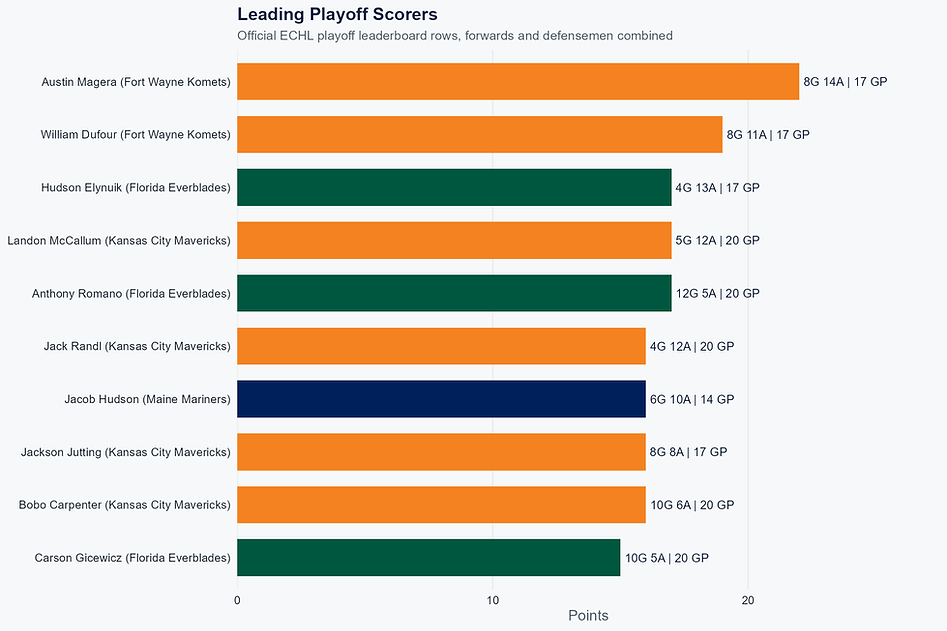
Leading Playoff Scorers
The Leading Playoff Scorers chart highlights the most productive offensive players during the 2025–26 Kelly Cup Playoffs, ranking skaters by total points while also displaying goals, assists, and games played. Postseason scoring is often a reflection of both individual talent and team success, as players advancing through multiple playoff rounds have additional opportunities to contribute offensively against increasingly difficult competition.
The Fort Wayne Komets led the playoff scoring race despite falling in the Western Conference Finals. Austin Magera finished atop the league with 22 points (8 goals, 14 assists) in 17 playoff games, while teammate William Dufour ranked second with 19 points, demonstrating the offensive firepower that helped propel Fort Wayne to one of the deepest playoff runs in the league. Their consistent production made the Komets one of the most dangerous offensive teams throughout the postseason.
The eventual champion Florida Everblades were equally impressive with balanced scoring throughout the lineup. Hudson Elynuik led the club with 17 points, while Anthony Romano and Carson Gicewicz each reached double figures in goals, illustrating the offensive depth that complemented Florida's outstanding defensive play and goaltending during its championship run. The Kansas City Mavericks, Kelly Cup finalists, also placed several players among the league leaders, including Landon McCallum, Jack Randle, Jackson Jutting, and Bobo Carpenter, reflecting the balanced attack that carried them to the Kelly Cup Finals.
One notable trend is that the league's scoring leaders overwhelmingly came from teams that advanced to the later rounds of the playoffs. While additional games naturally provide more opportunities to accumulate points, consistently producing against stronger opponents over an extended postseason requires exceptional offensive skill and consistency. Players from Florida, Kansas City, and Fort Wayne dominated the leaderboard because they combined individual excellence with sustained team success.
Overall, the chart illustrates the importance of offensive depth in postseason hockey. Rather than relying on a single superstar, the teams that advanced deepest into the Kelly Cup Playoffs featured multiple players capable of contributing timely goals and assists throughout the postseason. Florida's championship, Kansas City's run to the Finals, and Fort Wayne's offensive success all demonstrate how balanced scoring across the lineup remains one of the hallmarks of successful playoff teams.

Leading Playoff Goaltenders
The Leading Playoff Goaltenders chart highlights the netminders who had the greatest impact during the 2025–26 Kelly Cup Playoffs. Rather than ranking solely by save percentage, the chart emphasizes playoff wins while also presenting each goaltender's games played, minutes played, save percentage, goals-against average (GAA), and shutouts. This approach recognizes both performance and workload, providing a more complete assessment of postseason goaltending.
Leading the chart is Cam Johnson of the Florida Everblades, who backstopped the Kelly Cup champions to 16 playoff victories while appearing in all 20 postseason games. Johnson finished the playoffs with a .923 save percentage, a 1.88 goals-against average, and three shutouts, earning the June M. Kelly Playoffs Most Valuable Player Award. His consistency and ability to deliver in key moments were instrumental in Florida capturing its fifth Kelly Cup championship.
The Kansas City Mavericks, Kelly Cup finalists, received strong contributions from both Dylan Wells and Jack LaFontaine, who combined for 14 victories during Kansas City's run to the Finals. Taylor Gauthier of the Wheeling Nailers recorded nine playoff wins while posting a .922 save percentage, helping lead Wheeling to the Eastern Conference Finals. Samuel Jonsson of the Fort Wayne Komets also enjoyed an outstanding postseason, combining six victories with a .925 save percentage and two shutouts during Fort Wayne's deep playoff run.
The chart also demonstrates the balance between efficiency and workload that defines elite postseason goaltending. While several goaltenders posted outstanding save percentages over fewer appearances, those whose teams advanced to the later rounds accumulated substantially heavier workloads and were asked to maintain their performance over hundreds of additional minutes. Sustaining elite play throughout an extended playoff run is often what separates championship-caliber goaltenders from the rest of the field.
Overall, the chart reinforces one of hockey's enduring postseason truths: exceptional goaltending remains one of the strongest predictors of playoff success. The 2025–26 Kelly Cup Playoffs once again demonstrated that teams making the deepest postseason runs were anchored by dependable performances in net. Florida's championship, driven by Cam Johnson's remarkable playoff campaign, provides a compelling example of how elite goaltending can become the foundation of a title-winning team.