

Quebec Major Junior Hockey League - QMJHL - 2025-26 Season
League-wide standings, team performance dashboards, player leaders, goalie analytics, and advanced hockey insights powered by SEE Sports.
2025-26 Season Insights

QMJHL 2025-26 Regular Season Insights
• Moncton and Chicoutimi separated themselves from the field, finishing above 80% point percentage and posting dominant goal differentials of +138 and +171, respectively.
• Chicoutimi owned the league’s best goal differential and the strongest defensive profile, while Moncton paired elite offense with another top-tier defensive season.
• Blainville-Boisbriand, despite a +94 goal differential, underperformed its underlying numbers by nearly five wins, the largest negative gap in the league.
• Rimouski finished with the league’s worst goal differential (-144) but outperformed expectations by more than five wins, showing an ability to collect points despite being heavily outscored overall.
• The team identity map highlights a clear divide: Moncton, Chicoutimi, and Blainville-Boisbriand combined strong offenses with stingy defenses, while Baie-Comeau and Rimouski struggled at both ends of the ice.
QMJHL Offense vs. Defense Team Profiles

QMJHL Offensive vs. Defensive Balance
• Chicoutimi and Moncton paired elite offenses with outstanding defensive play, creating the league’s widest positive gaps between goals scored and goals allowed.
• Blainville-Boisbriand joined the top tier with more than four goals per game while allowing fewer than three, giving the Armada one of the most balanced profiles in the league.
• Shawinigan, Newfoundland, Drummondville, and Rouyn-Noranda all posted strong positive scoring margins, relying on solid defensive structure rather than overwhelming offense.
• Sherbrooke and Québec played low-event hockey, with both goals for and goals against clustered around 3.3 per game and very little separation between the two.
• Rimouski and Baie-Comeau struggled most at both ends of the ice, combining bottom-tier offenses with some of the league’s highest goals-against averages.
2025-26 QMJHL Special Teams

QMJHL Special Teams Identity
• Chicoutimi and Moncton stood alone as the league’s elite special teams clubs, combining top-tier power plays with penalty kills above 82%.
• Rouyn-Noranda and Blainville-Boisbriand also excelled on both sides of special teams, finishing comfortably above league average in power-play and penalty-kill efficiency.
• Cape Breton owned one of the league’s best penalty kills (above 80%) but lagged offensively on the power play, relying more on shorthanded strength.
• Newfoundland generated one of the stronger power plays in the league but paid the price with a below-average penalty kill, creating an imbalanced profile.
• Rimouski, Baie-Comeau, and Drummondville struggled most on special teams, posting both below-average power plays and penalty kills and occupying the bottom-left quadrant.
2025-26 QMJHL Goalie Performance
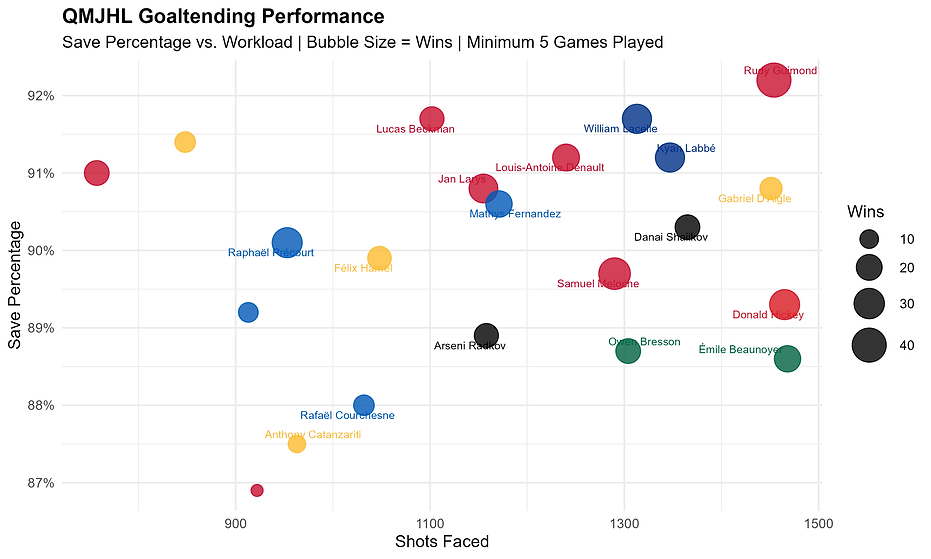
QMJHL Goaltending Performance
• Rudy Guimond delivered the league’s most impressive combination of workload and efficiency, posting a save percentage above 92% while facing one of the heaviest shot totals.
• William Lacelle and Kyan Labbé anchored elite teams with save percentages above 91%, combining strong performance with workloads exceeding 1,300 shots faced.
• Mathys Fernandez and Louis-Antoine Denault provided stability for contenders, both maintaining save percentages above 90.5% with substantial workloads.
• Several heavily used goaltenders, including Donald Hickey and Émile Beaunoyer, faced more than 1,400 shots but finished below the 90% mark, highlighting the challenges posed by weaker defensive environments.
• Overall, the league featured remarkable parity in net, with most starting goaltenders clustered between 89% and 91% save percentage despite wide differences in workload.