

2025-26 USHL Playoffs
2025–26 USHL Clark Cup Playoffs at a Glance
🏆 Clark Cup Champion: Sioux Falls Stampede
🥈 Runner-up: Muskegon Lumberjacks
🏒 Clark Cup Final: Sioux Falls defeated Muskegon, 3–1 (best-of-five series), clinching the championship with a dramatic 4–3 double-overtime victory in Game 4.
⭐ Clark Cup Playoff MVP: Linards Feldbergs, Sioux Falls Stampede. The Merrimack commit finished the playoffs with a 1.91 goals-against average, .939 save percentage, and two shutouts, including a remarkable .952 save percentage during the Clark Cup Final.
📅 Playoff Format: Six teams from each conference qualified for the Clark Cup Playoffs. The opening round featured best-of-three series between the No. 3–6 and No. 4–5 seeds, while the Conference Semifinals, Conference Finals, and Clark Cup Final were all contested as best-of-five series. The top two seeds in each conference received first-round byes.
👥 Teams Qualified: 12 (Top six teams from both the Eastern and Western Conferences.)
🥅 Championship Notes:
-
Sioux Falls captured its fourth Clark Cup championship, adding to titles won in 2007, 2015, and 2019.
-
The Stampede defeated defending champion Muskegon Lumberjacks in the Clark Cup Final after advancing through Lincoln and Fargo in consecutive five-game series.
-
The championship was secured in dramatic fashion when Joey Macrina scored the double-overtime game-winning goal in Game 4.
-
Goaltender Linards Feldbergs anchored Sioux Falls throughout the postseason and earned Clark Cup Playoff MVP honors with one of the most dominant playoff performances in recent USHL history.
🎯 Featured on This Page:
-
Team Playoff Performance by Goal Differential
-
Offense vs. Defense Analysis
-
Leading Playoff Scorers
-
Leading Playoff Goaltenders
-
Season-in-review commentary and analytical insights
2025–26 USHL Clark Cup Playoffs: Season in Review
The 2025–26 USHL Clark Cup Playoffs delivered another exciting postseason, culminating in the Sioux Falls Stampede capturing the Clark Cup by defeating the defending champion Muskegon Lumberjacks three games to one in the championship series. Sioux Falls combined timely scoring, disciplined defensive play, and exceptional goaltending throughout the playoffs, earning the organization's fourth Clark Cup championship and its first since 2019.
Sioux Falls' path to the title was anything but easy. After advancing through the Western Conference bracket with hard-fought series victories over Lincoln and Fargo, the Stampede faced a talented Muskegon squad that had successfully defended its Eastern Conference title and entered the Finals seeking back-to-back Clark Cup championships. The championship series featured fast-paced, competitive hockey, highlighted by Sioux Falls clinching the title with a dramatic double-overtime victory in Game 4, showcasing the resilience and depth that defined the Stampede throughout the postseason.
A major factor in Sioux Falls' championship run was the outstanding play of goaltender Linards Feldbergs, who earned Clark Cup Playoff MVP honors. Feldbergs posted a 1.91 goals-against average, a .939 save percentage, and two shutouts, consistently delivering elite performances during the league's biggest moments. Combined with balanced scoring throughout the lineup and a commitment to team defense, Sioux Falls demonstrated the complete style of play needed to navigate the challenges of postseason hockey.
The 2025–26 Clark Cup Playoffs also featured outstanding performances from teams across the USHL. Muskegon once again proved to be one of the league's elite organizations by returning to the championship series, while clubs such as Fargo, Lincoln, and the remaining playoff qualifiers showcased the depth of talent across one of the world's premier junior hockey leagues. As is often the case in playoff competition, success was driven not only by offensive production but also by disciplined defensive play, strong special teams, and consistent goaltending.
The visualizations presented on this page provide a comprehensive statistical review of the 2025–26 Clark Cup Playoffs. Team-level analyses examine which clubs most effectively balanced offensive production with defensive efficiency, while player leaderboards recognize the postseason's top scorers and goaltenders. Together, these analytics complement the playoff results by illustrating the performances that shaped the race for the Clark Cup and ultimately propelled the Sioux Falls Stampede to another league championship.

Team Playoff Performance by Goal Differential
The Team Playoff Performance by Goal Differential chart summarizes how each team performed during the 2025–26 USHL Clark Cup Playoffs by comparing total goals scored and goals allowed throughout the postseason. Goal differential is one of the strongest indicators of playoff success because it reflects a team's ability to consistently outscore its opponents over multiple games. Positive values indicate teams that scored more goals than they allowed, while negative values represent teams that were outscored during their playoff run.
The Sioux Falls Stampede, the eventual Clark Cup champions, led all playoff teams with a +13 goal differential, demonstrating the balanced offensive and defensive play that carried them to the league championship. Close behind were the Muskegon Lumberjacks at +11, highlighting the strength of the defending champions during their return to the Clark Cup Final. Together, the two finalists clearly separated themselves from the rest of the playoff field, underscoring the consistency each club displayed throughout the postseason.
Among the remaining semifinalists, the Lincoln Stars and Fargo Force each finished with a +2 goal differential, reflecting competitive playoff performances despite falling short of the championship series. Several teams—including Youngstown, Sioux City, Madison, and Green Bay—finished near even, illustrating how tightly contested many first- and second-round series were. Small goal differentials often indicate that only a few key plays or timely performances can determine the outcome of a playoff series.
At the opposite end of the standings, Dubuque Fighting Saints (–7), Des Moines Buccaneers (–6), Tri-City Storm (–5), and Cedar Rapids RoughRiders (–4) recorded the largest negative goal differentials, reflecting the challenges they faced against stronger postseason competition.
Overall, the chart reinforces one of hockey's most consistent postseason trends: teams that combine offensive production with disciplined defensive play are best positioned to make deep playoff runs. Sioux Falls' league-leading goal differential accurately reflects the dominant two-way hockey that produced the 2025–26 Clark Cup championship, while Muskegon's strong differential illustrates why the Lumberjacks once again reached the league finals. Although goal differential is not a guarantee of playoff success, it remains one of the clearest statistical measures of sustained team performance throughout the postseason.

Offense vs. Defense
The Offense vs. Defense chart compares each team's offensive production (goals scored per game) with its defensive performance (goals allowed per game) during the 2025–26 USHL Clark Cup Playoffs. Teams positioned farther to the right generated more offense, while teams appearing higher on the chart allowed fewer goals per game because of the inverted defensive axis. Teams occupying the upper-right quadrant combined high-powered offense with strong defensive play, a balance that is often the hallmark of championship-caliber teams.
The two Clark Cup finalists, the Sioux Falls Stampede and Muskegon Lumberjacks, clearly occupied the most favorable region of the chart. Both teams averaged more than three goals per game while limiting opponents to fewer than 2.7 goals per contest, demonstrating the balanced style of play that carried them to the championship series. Sioux Falls, the eventual Clark Cup champion, paired one of the league's highest-scoring offenses with one of the strongest defensive performances, illustrating why the Stampede successfully navigated three playoff rounds to capture the title.
Among the remaining semifinalists, the Fargo Force also displayed an impressive balance between offense and defense, while the Lincoln Stars generated one of the postseason's highest offensive outputs but allowed more goals than the other top contenders. Sioux City produced solid offensive numbers but finished closer to the league average defensively, highlighting how even small differences in goals allowed can influence playoff outcomes in closely contested series.
Several first-round participants exhibited contrasting styles of play. Youngstown and Green Bay ranked among the strongest defensive teams by allowing approximately two goals per game, but both generated comparatively modest offensive production. Conversely, Des Moines, Tri-City, and Dubuque struggled defensively while producing moderate offensive numbers, making sustained postseason success more difficult. Madison and Cedar Rapids fell near the middle of the offensive spectrum but allowed more goals than the league's top-performing clubs.
Overall, the chart reinforces one of hockey's most consistent postseason patterns: teams that advance deepest into the playoffs are typically those that excel on both sides of the puck. Sioux Falls and Muskegon demonstrated the ideal balance of offensive efficiency and defensive reliability throughout the 2025–26 Clark Cup Playoffs, while Fargo's strong overall profile further illustrates the importance of maintaining consistency in all phases of the game during the pursuit of a championship.
Leading Playoff Scorers
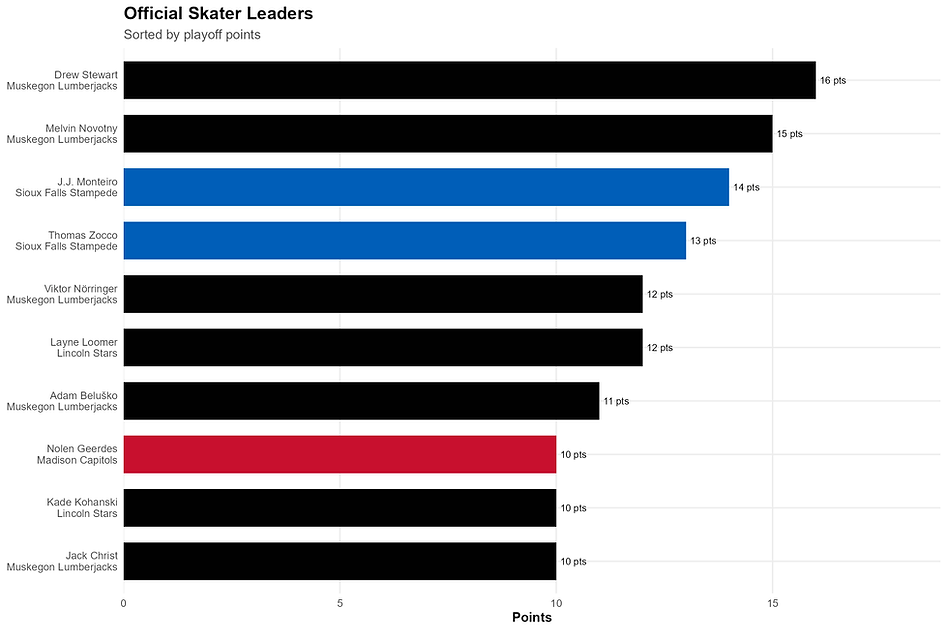
The Leading Playoff Scorers chart highlights the players who recorded the most points during the 2025–26 USHL Clark Cup Playoffs. Ranked by total postseason points, the leaderboard recognizes the skaters who made the greatest offensive impact while helping their teams advance through the playoffs. Because teams that progress further naturally play more games, the scoring leaders often reflect both outstanding individual performance and deep postseason success.
Leading all playoff scorers was Drew Stewart of the Muskegon Lumberjacks, who finished with 16 points during Muskegon's run to the Clark Cup Final. Teammate Melvin Novotny followed closely with 15 points, giving the Lumberjacks the top two scorers in the postseason. Their offensive production was instrumental in Muskegon's return to the championship series and demonstrated the high-powered attack that made the Lumberjacks one of the league's most dangerous playoff teams.
The eventual champion Sioux Falls Stampede countered with outstanding offensive balance. J.J. Monteiro finished with 14 points, while Thomas Zocco added 13 points, providing the consistent scoring that helped Sioux Falls capture the Clark Cup. Rather than relying on a single offensive star, the Stampede received timely contributions throughout their lineup, complementing strong defensive play and elite goaltending during their championship run.
Several other players also enjoyed outstanding postseasons. Viktor Nörringer (Muskegon) and Layne Loomer (Lincoln) each recorded 12 points, while Adam Beluško (Muskegon) contributed 11 points. Nolen Geerdes of the Madison Capitols, Kade Kohanski of the Lincoln Stars, and Jack Christ of Muskegon rounded out the leaderboard with 10 points each, highlighting the offensive talent spread across several playoff clubs.
Overall, the scoring leaderboard illustrates the connection between offensive production and postseason success. Muskegon dominated the individual scoring race with five players among the top ten, reflecting the depth of its attack throughout the playoffs. However, Sioux Falls demonstrated that balanced scoring across the roster, combined with disciplined team defense and exceptional goaltending, can ultimately prove more valuable than simply producing the league's highest individual point totals. The 2025–26 Clark Cup Playoffs once again showed that championship teams are built on both star performances and contributions from throughout the lineup.

Leading Playoff Goaltenders
The Leading Playoff Goaltenders chart highlights the netminders who had the greatest impact during the 2025–26 USHL Clark Cup Playoffs by emphasizing playoff wins while also presenting games played, minutes played, save percentage, goals-against average (GAA), and shutouts. By combining workload with traditional goaltending statistics, the chart recognizes the goaltenders who consistently performed at a high level while leading their teams through multiple playoff rounds.
Leading the chart is Linards Feldbergs of the Sioux Falls Stampede, who backstopped the Clark Cup champions to nine playoff victories while appearing in 14 postseason games. Feldbergs finished the playoffs with an outstanding .939 save percentage, a 1.91 goals-against average, and two shutouts, earning Clark Cup Playoff MVP honors. His remarkable consistency and ability to make timely saves throughout the postseason provided the foundation for Sioux Falls' fourth Clark Cup championship.
Matching Feldbergs with nine playoff wins was Carl Axelsson of the Muskegon Lumberjacks, who carried the defending champions back to the Clark Cup Final. Axelsson appeared in 16 playoff games, the most among qualifying goaltenders, while posting a .912 save percentage and 2.17 goals-against average. His heavy workload and dependable play were instrumental in Muskegon's return to the championship series.
Among the remaining playoff teams, Caleb Heil of the Madison Capitols delivered one of the postseason's strongest statistical performances, recording seven victories, a playoff-best .944 save percentage, a 1.95 goals-against average, and a shutout. Ajay White of the Fargo Force added five wins while posting an impressive .933 save percentage, helping Fargo advance to the Western Conference Finals. Charles Menard (Lincoln) and Jack Fichthorn (Sioux City) also produced solid postseason performances, while the remaining goaltenders on the leaderboard contributed important efforts during their teams' playoff appearances.
Overall, the chart reinforces one of hockey's enduring postseason truths: elite goaltending is often the difference between a deep playoff run and an early exit. While several netminders posted exceptional efficiency, Sioux Falls combined Feldbergs' outstanding play with balanced scoring and disciplined team defense to capture the Clark Cup. The results demonstrate that sustained playoff success depends not only on outstanding save percentages, but also on the ability to maintain elite performance under the heavy workload required to win a championship.